
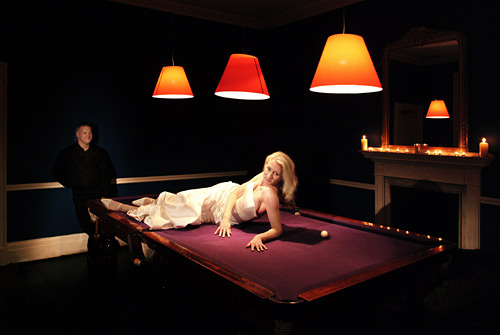
As the nights are drawing in it's once again time to get used to having fun with long exposures. I lit the groom in this shot with a Luxman battery light. ISO 800, 1/8th second at f/8. I bought the battery light online from B&H in New York.
When the weather is bad, or it’s dark outside don’t let your creativity evaporate. Rise to the challenge and embrace a whole new set of opportunities. There really is no escape from the fact that if you are going to shoot weddings you need to have total command of your artificial light sources. Super sensitive cameras can help as the next 2 pictures show.
Click on the dancing picture to see the full size Canon 5Dmk11 picture taken at ISO6400 (19Mb)
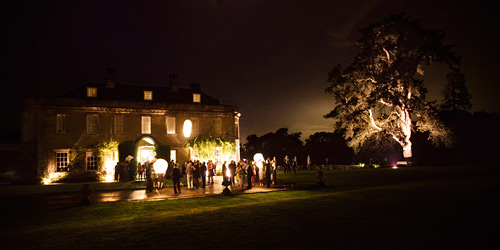
I took this on a Canon 5D mk11 at ISO 6400. For all intents and purposes it was pitch black bar the lanterns being lit and the light on the tree. 1/2 second exposure at f/2.8 using ISO 6400. The shot is very acceptable even as a 12" print.
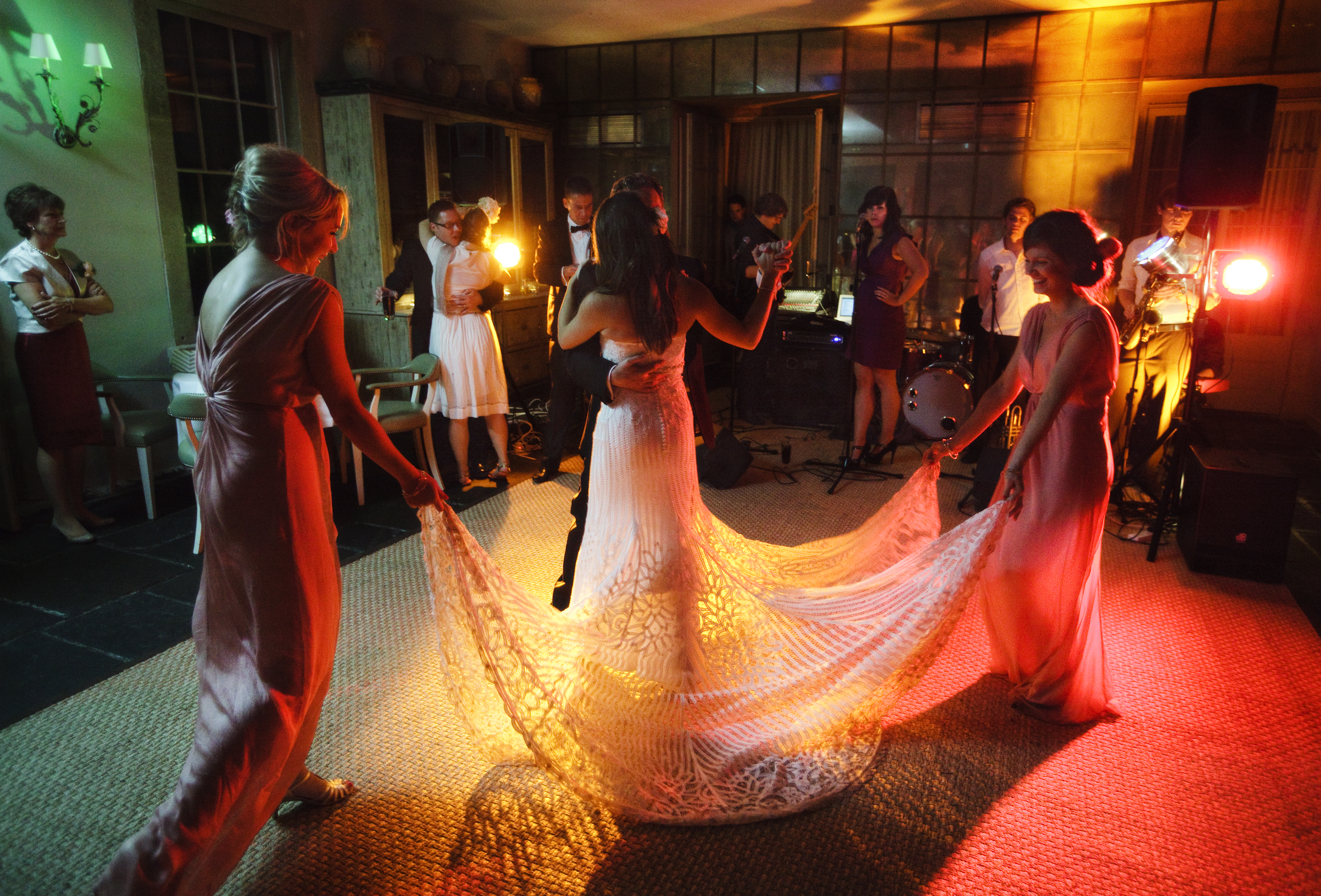
This ISO 6400 wedding picture shows just what is available from a very dark scene. It was a struggle to see. I set up a Speedlight out of shot on the left and triggered it with an ST-E2 on my 5D mk11 camera. I've chosen a frame that doesn't reveal the bride on purpose. Click on the picture to see it at 100%. Remember this is ISO 6400
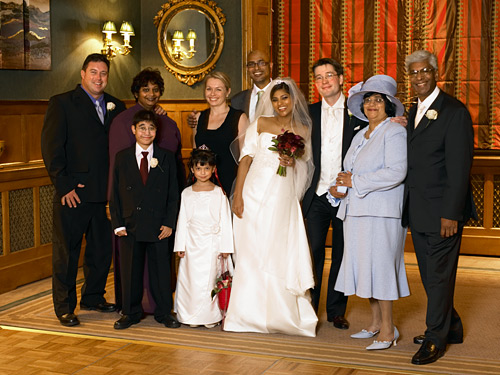
1 second was the exposure time needed to render the ambiance in this shot. I switched the main chandelier off in order to keep the ambient light off the guests. I lit them with flash from a white umbrella on my Broncolor Mobil. If they were lit significantly with continuous light for this length of time their movement would have been recorded as a blur. ISO200 f/5.6, 1 second exposure.
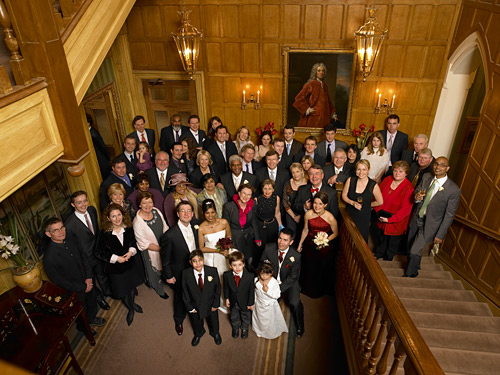
I used the same Broncolor Mobil kit for this shot too. 1/4 second at f/7.1 using ISO200. I kept the ISO low for ultimate quality. f/7.1 ensured sharpness from front to back and the long exposure allowed the wall lights to render beautifully.
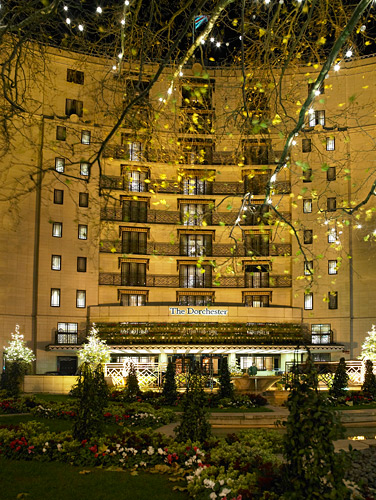
Don't forget to take a night or dusk shot of the wedding venue. I used a tripod to take this shot of the Dorchester on Park Lane. 1 second, f/5.6 at ISO 400.
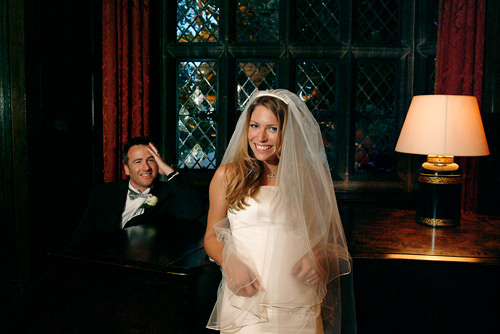
1/10th second at ISO 800 with my camera on a monopod was needed to ensure the ambient light was recorded on this frame. I used a splash of flash with a Sto-Fen held off camera in my left hand with the camera in my right hand.
Placing a Speedlight on camera is generally to be avoided. It creates flatly lit pictures that could easily have been taken by uncle Henry. The solution I adopted from a few press photographer friends back in 1998 was to use the Speedlight hand held off camera. I held the flash in my left hand and the camera in my right hand. Ten years on and this system is still used by us and many of the top wedding shooters. Here are my recently updated kit choices for wedding shooting.
Nikon:
Use a D700 or D3 (If you have big muscles) and add an SU800 commander. You can use the pop up flash on your D700 camera as a non-firing commander but it won’t give you that vital red focus aid illumination that the SU-800 uses plus the communication pre flashes can cause blinks. Set the SU-800 to trigger your SB800 or SB900 Speedlight in TTL and finally fit the flashgun with the diffusing dome that it came with. Julie prefers to use the SC29 coiled lead by Nikon. It is cheap, light and totally dependable. Again, it has the built in red focus aid illuminator and those leads without one should be avoided. Julie also prefers the less bulky SB800 to the new SB900. Looking further ahead, I expect Pocket Wizard will have perfected the Nikon version of their radio TTL trigger system by early 2010 and will have made it available in the UK.
Canon:
Use a 5D or a 5D Mk2 camera, I find the 1Ds series cameras are just too heavy for single handed use. Fit a Sto-Fen omnibounce diffuser. There are other makes available, but try to avoid looking like a Belisha beacon. Fit your camera with a Canon STE2 transmitter and away you go. Unfortunately the Canon coiled lead is a bit too short and there is no infra red focus aid built into it so it becomes next to useless when the going gets tough at night. If you use the Pocket Wizard MiniTT1 and the FlexTT5 radio set up you should use the ST-E2 on the Mini TT1 to provide focus aid illumination.
Whatever kit you choose you can make small adjustments to the flash output by using the on camera flash exposure compensation or the on flashgun exposure compensation. Simply adjust it to taste using the camera screen as feedback and away you go.
The message here is don’t be scared to use long exposures with flash, use a monopod or tripod and give high ISO a try. If the ISO setting is available without resorting to the extended range on your camera it means the manufacturer has deemed it okay to use.
Practice at home first; Set out a candle lit dinner, do a few test shots, eat the dinner and examine the shots the next morning.
Please comment below.
If you found this helpful, you may also like to read How to shoot winter weddings – A guide.
Hi Damien, In the photo of the group at the base of stairs, you say you used your broncolour. Did you use one head? Do you set the camera for the ambient and then manually adjust flash to suit? I have 500w Gemini pros, would one be enough bearing in mind your broncolours are I believe 1600?
Regards
Steve
PS. If you get a chance, I could do with the info ASAP as I’m shooting wedding tomorrow and the weathers not looking good!
Hi Steve,
Sorry for the delay in replying. I’ve been on holiday. I used half power (600Ws) and a white translucent umbrella.
Kind regards, Damien.
I’m using the Nikon D700 with the on board flash triggering two speedlights. Works really well for me, especially being able to control the speedlights from the camera rather than going over to the flashes to change them.
Hi Dave,
I have both cameras. I’d say the mk2 has 1.7 stops of noise advantage. Cheers, Damien.
Hi Damien hope your well, a slight off shoot from this subject, but still relevent for winter shoots. What would you say the comparison is in “noise” between the old 5d and the mark 2? for example does 1600 iso on the new 5d give as good an image as 800 iso on the older one?
Cheers
Dave
A timely blog entry as the nights start to get dark so quickly! Thanks Damien!
As a Nikon shooter eagerly awaiting the compatable TT1, will an SU800 be required as a focus aid or can an sb800/900 be used with the flash output turned off? I have a broken SB800 that’s perfect as a focus aid but sadly not much else.
Rob
Damien,
It’s a pleasure to talk with you. This answers me just fine. In the process of buying new lenses for a DX set up.
S P I K Y J U M P E R © has been my photography identity for some years now. Have you any thoughts on how it might work as a wedding photography business name? Portrait clients in my local community love it.
Spikyjumper
Hi Spikyjumper,
Great screen name :) My focal length suggestion is okay for any sensor size. Way back, when I was shooting weddings on a Fuji S2 or Nikon D200 I had a 17-35mm f/2.8, 28-70mm f/2.8 and a 70-200mm f/2.8. These were fine.
Now that Julie and I shoot using a D700 and a 5Dmk2 respectively we still use the same sort of focal lengths. I do have a 16-35mm f/2/8 but I rarely go wider than 24mm at a wedding. We both still have the 70-200mm f/2.8 lenses and we don’t have a need for a 300mm.
The most important factors are maximum aperture and not focal length range. I hope this helps.
Damien.
Hi Michaelbs,
I understand your situation. I’m sure future firmware revisions of the PWs will deal with the issue of ‘switch on order’.
Happy shooting,
Damien.
plevyadophy,
I’ve noticed no difference in AF beam power from any unit or Speedlite. Some Speedlites have 3 emitters but this is to cover more AF points not to increase light intensity.
Cheers, D.
Off subject below but I’ve been advised to us this blog to have my question answered.
Damien, you often mentions the use of two pro lenses covering a focal length of 17-200 mm, do you mean to include the 1.5x multiplication many DSLR sensors have on lens focal lengths when you say this? What I’m asking is do you mean to say ‘use lenses that cover a 35 mm film camera equivalent of 25.5-300 mm’? Or should I be looking at a coverage of 12-133 mm for use with a DX frame DSLR, thus bringing it to roughly 17-200 mm once the 1.5x multiplication has been applied.
Am I making sense?
Damien said: “if you are not using flash and you are just using the ST-E2 to focus aid why bother with the Mini? Just use the ST-E2 and there will be no work around needed.”
Just to clarify: when I want to shoot with off camera flash ie during the wedding dance/party and I use the miniTT1 to trigger the 580ex/flexTT5 and I decide to some shots without flash and then some again with flash and so on and so forth. Then it’s nice to know that I can take advantage of the beam-aid wether or not I have the off-camera flash turned on.
Dear Sir,
Oh yes. Sily me!! Yes, I should have engaged my brain before writing on a public forum/blog for all the world to see! :-)
Yeah, it’s not the stopping down that matters it’s the lenses maximum aperture (at which it will acheive focus) that matters. Therefore, I can now stop being concerned as even by my figures, with an f2.8 lens, I could stand at about 15 feet away from my subject and acquire focus.
But still, it would be interesting to know if those Canon and Nikon devices have a bit more oomph than the AF beam of the Speedlites. Would you care to do a test for us? ;-)
Regards,
And thanks for the continued education.
plevyadophy
Hi plevyadophy,
Thanks for your comments and questions. I have no interest in the numbers – feet, meters, apertures etc. What question interests me is “Do the illuminators work”? and my answer is yes. With the proviso you have fast lenses and a decent camera you can shoot parties indoors at night in the dark.
Stopping down an f2.8 lens to f/11 to take a picture has no effect on the IR beams ability because the focusing happens before the lens is stopped down. It’s only the max aperture of a lens that is important.
Just get out there and shoot. Give it a go and you will soon discover that the numbers don’t tell you nout. Learn the limits for yourself and you’ll realise that the big variables arn’t makes of kit but subjects and ambient conditions. If the person you are shooting is wearing black, has black hair and is turned away from you then focus will be harder than if they are wearing white and blue stripey shirt. or have glasses etc.
All the AF illuminators I’ve used inc Metz seem to do a good job. Some cover more focus zones but I only use the middle one so that means nout to me.
Focus Assist in low light
===================
Dear Sir,
In respect of focus assist you said the following
— Quote —
Nikon:
Use a D700 or D3 (If you have big muscles) and add an SU800 commander. You can use the pop up flash on your D700 camera as a non-firing commander but it won’t give you that vital red focus aid illumination that the SU-800 uses plus the communication pre flashes can cause blinks. Set the SU-800 to trigger your SB800 or SB900 Speedlight in TTL and finally fit the flashgun with the diffusing dome that it came with. Julie prefers to use the SC29 coiled lead by Nikon. It is cheap, light and totally dependable. Again, it has the built in red focus aid illuminator and those leads without one should be avoided. [Julie also ……..]
Canon:
Use a 5D or a 5D Mk2 camera, I find the 1Ds series cameras are just too heavy for single handed use. [ …..] Fit your camera with a Canon STE2 transmitter and away you go. Unfortunately the Canon coiled lead is a bit too short and there is no infra red focus aid built into it so it becomes next to useless when the going gets tough at night. If you use the Pocket Wizard MiniTT1 and the FlexTT5 radio set up you should use the ST-E2 on the Mini TT1 to provide focus aid illumination.
——- End Quote ———–
What I am curious to know is how good those infra-red illumintors really are? And at what sort of light levels? And what sort of distance?
The reason I am really curious is that my Metz speedlite’s red AF assist light has a range of 9m with a 50mm f1.7 lens (which equates to 6.2m @ f2, 4.4m @ f2.8, 3m @ f4, and 2.2m @f5.6). As far as I am aware (correct me if I am wrong) other brand speedlites aren’t that much better and those figures don’t look that impressive once you stop down beyond f2.8.
So I am VERY curious to know if the Nikon cable in particular and the Canon ST-E2 you speak of have a far more powerful AF beam?
Thanks in advance.
Regards,
Hi Damien
Wow – great shots. Tremendous impact.
I’m saving up for a Mini and FlexTT5…. ;o)
Rich
Hi Michael,
I’ve only used the Mini & ST-E2 when I’ve got a flash on my Flex and that flash is usually a 580EX11 because I have 2 of them. So I have not experienced your situation.
If you are not using flash and you are just using the ST-E2 to focus aid why bother with the Mini? Just use the ST-E2 and there will be no work around needed.
Damien.
Hi Dave,
The flash and ambient exposures are not linked. Think of them as seperate entities. Put the camera in manual. Get the ambient to look how you want it to without flash and then add the flash. You can knock the flash back a stop or up a bit using the flash exposure compensation on the camera.
Damien.
Hi Sean, Ross and Phil,
Thanks for your kind words. I agree it has been dark lately. I’m sure it is more fashionable to light venues to a dimmer level recently. Claridges felt like it was in a blackout. I will post the Claridges shots once the B&G have seen them and given me the go ahead.
Phil, this was the last of my weddings before I had fully checked out the new PW’s. I never test at weddings ;-) The week later I used them in Claridges to great success. I was tingling with excitement being able to light round corners and from the floor above on the staircase. It was such fun. I felt like a child playing with new toys.
Damien.
I noticed something strange: if I want to use the focus beam ST-E2 on top of the miniTT1 it won’t work unless I power on the FlexTT5 with a 580exII on top. Then I can use the focus aid beam. I can then turn off the FlexTT5 and speedlight and the ST-E2 focus aid illumination still works! But only with the described workaround.
Are you experiencing the same?
Hi damien, can you explain how you stop your flash over powering the ambient light? Do you take a picture without flash to figure out the ambient light 1st then add a blast of flash using ttl knocking it back if it’s overpowering? Your last photo is lighting perfection.
Will you be doing a blog on your honl correction filters I just bought from you? Many thanks.
Hi Damien,
You have some very nice pictures here. I just love the way you explain in detail how you shot them.
The quality of the dancing picture(6400 iso) is excellent. I would be interested to know why you used the STE-2 instead of your new pocket wizards ?
Kind regards
Phil
Thanks for this update. Very helpful.
Damien,
Nice to get a refresher. Seems I have been shooting in “Coal Mines” for my last few weddings and the st-e2 and hand held flash has helped a lot. 5D Mark 2, I find usable to about iso 3200 in dark rooms for the dancing etc.
Sean
http://www.energyphotographic.co.uk