
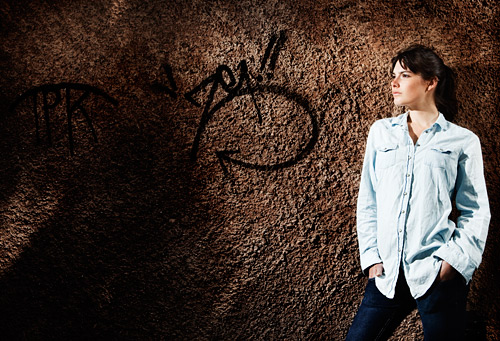
Ratio class for key and kick. A simple shot like this lit with 2 Speedlights makes an ideal test bed for using ratios. I always set group A to the left of the shot and group B to the right of shot. That way it is easy to keep track of what's happening. In this shot the ratio on my ST-E2 was set to 2:1 towards A. This actually leaves A set to normal and cuts B to half power.
The wall in the shot above is at the Architecture Center on the Bristol waterfront. I really like the tagging here as it is an example of simplicity in design and graphic elegance. Unlike the scrawled initials often found left by vandals.
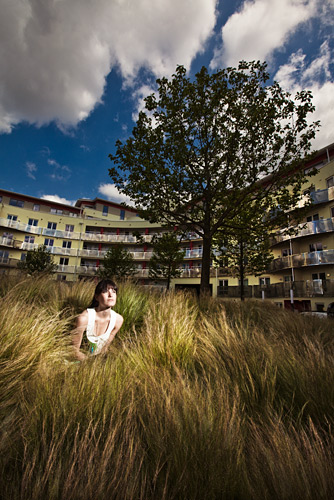
Now you've seen this grass before but I thought I'd show you the setting it is in. Just out of shot on the right is my 430 EX2 Speedlight on a stand.
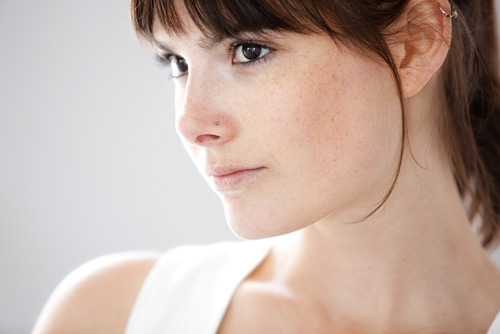
Natural light key and kick 2 point lighting is my favourite technique of the moment. The rimlight on this high key shot is sublime. A good framing choice to show a client is a crop that cuts of the right of the frame to leave a square. Put your hand on the screen to see what I mean. Never just take your camera aspect ratio as standard.
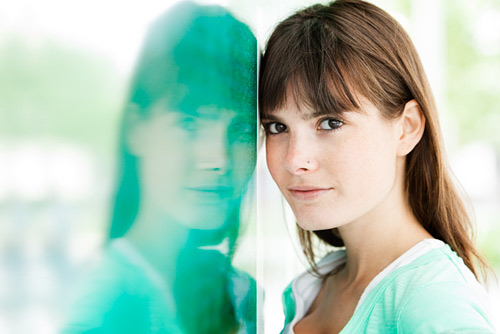
HBOS provided the glass in the ground floor of their building and I decided to shoot a reflection shot. I can get away with the obvious distortion in this reflection because it is narrowing of the face.
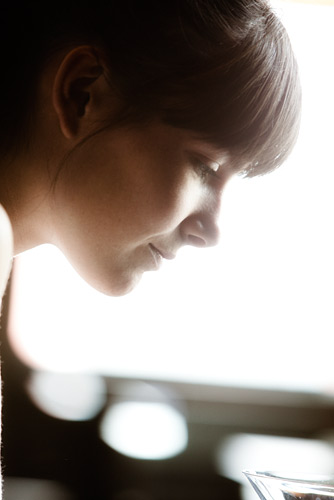
Challenging light rewards the brave photographer with beauty. This is 1 part of a 2 part set. The second shot is below.
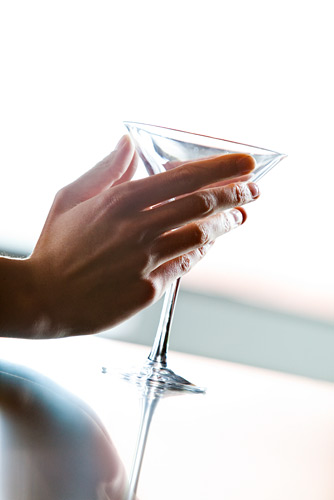
My camera must have slipped because I never shoot pictures on angles ;-)
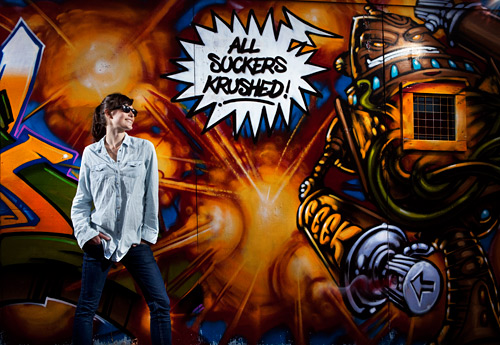
You can't go wrong with the street art of Bristol. Banksy set the standard here and I love to record what we have as it's so transient. Within a few weeks this will be gone for good. The lighting was 2 Speedlights on stands set at equal power on TTL. I used f/18 @ 1/200th and ISO 200 on my 5D mk2 to capture this shot.
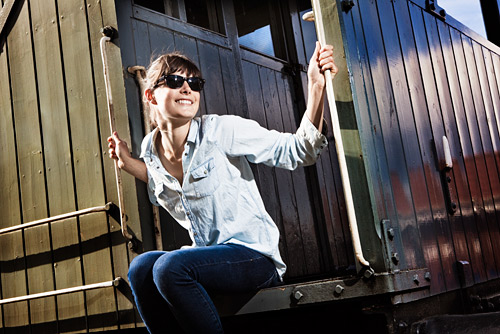
You'll see this shot taken many times but it is always different. The reflections, sky, my lighting balance and the pose make a shot like this seem fresh and exciting every time. 2 Speedlights again set to an even ratio. Manual exposure mode, TTL flash, f/22 at 1/200th second and ISO 200.
If you have a comment or question please feel free to comment below. I try my best to answer every question I can.
Damien.
Hi Michaelbs,
I only use three lenses with my Canon. A 16-35mm f/2.8, a 24-70 f/2.8 and a 70-200 f/2.8. I find that the working distance is far more important than focal length when shooting this kind of flash portraits. If I am working with natural light I often get the chance to use a shallow depth of field and then focal length / aperture combination becomes more important.
Take a look through my other Urban Portrait posts. Because I regularly include a wider shot showing flash placement.
Blogging these images can begin to show the nuts and bolts of the construction, give you some inspiration but they can’t show the detail of compositional thought, the subtleties of model / customer direction or how to rig Speedlights on sloping ground for instance. For the whole picture, there is nothing quite like coming out with me for the day on a workshop.
Kindest regards, Damien.
Hi Dave, Well spotted. It’s the camera that was set to Manual. The Speedlights were on TTL. My error for ambiguous captioning.
Damien.
Damien,
Nice set of images.
The last two images have even balanced light between the speedlights but in one you use TTL, whilst in the other you use manual. Why the switch?
Thanks
Dave.
Thanks for your excellent posts and DVD’s. One request: it would be helpful if you included focal length info as well.
Also if you included a wider shot so we could see the actual height and placement of the speedlights.
Thanks so much.