

Sunlit elegance and love cast shadows on Blenheim Palace
This feature length post sets out expert advice for professional wedding photographers.
In this post I’ll be sharing with you a series of pictures Julie and I shot for an American bride at the famous Hempel Hotel in London. Since the hotel is known for its stark, minimalist décor, we all agreed it might be fun to reflect this in the photography. As a result most of the images are strong, simple, uncluttered compositions in black and white with a few colour shots for contrast. The hard, directional lighting I chose to use also brings out the angularity of the hotel’s interior design. Above all, our aim was to make these images elegant and stylish – just like the bride and groom.
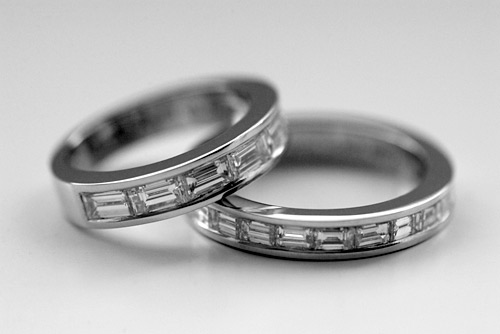
A photograph of these eternity rings was important to the couple. It always pays to include special details like this.. ISO 800 f/4 at 1/500th
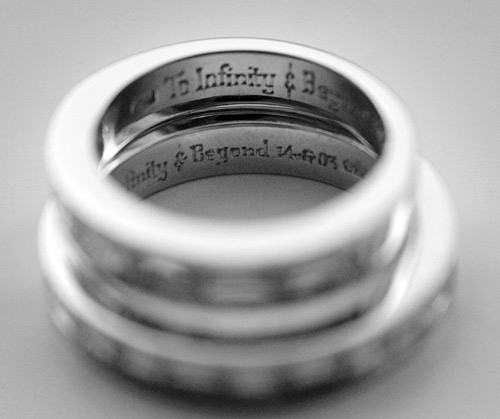
It didn’t make it any easier that the inscription was on the inside of the rings! So I used a shallow depth of field to emphasise the message. ISO 800 f/4 at 1/500th
In the past few years the wedding photography market has exploded with creativity. It’s hard to imagine there ever being a time when the vast majority of wedding photographers followed the guidelines set out in the ‘How to photograph weddings manual’. That traditional system of working used in the last century certainly had it’s advantages, It set minimum standards of acceptable quality and provided easy to follow instructions complete with pictures for newcomers to the industry. Since the late 90’s we’ve been transported into a state of relative chaos where wedding photographers have developed individual styles and use a super set of buzz words to describe them: Storybook, reportage, candid, lifestyle, photo Journalistic, contemporary etc. But it still seems that customers are by and large unsure what these words mean.
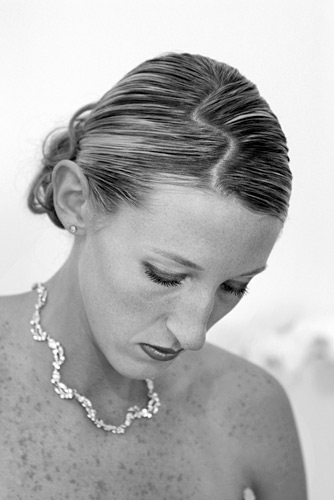
The bride was obviously proud of her hair style so Julie made a feature of it with this shot. A blip of flash high above the camera acts as a ‘hair light’ while the pensive expression reflects the gravity of the occasion. ISO 400 f/4 at 1/60th
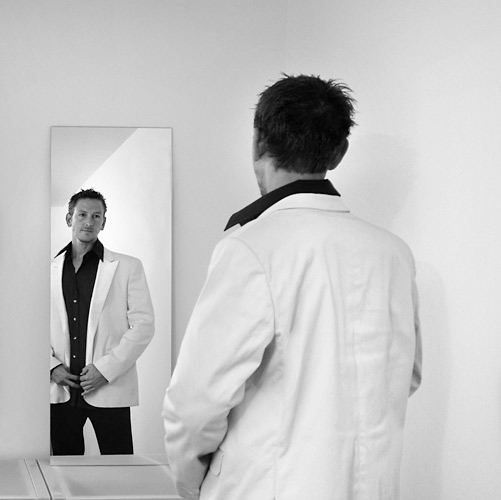
An interestingly complex portrait: mirrors are great for adding extra depth – and a touch of mystery – to a composition. Here I bounced flash off the wall behind me: this increases the apparent depth and draws the viewer towards the bright highlight behind the mirror image of the groom. ISO 400 f/4 at 1/125th
Top tip No 1: Select your product and style describing words carefully. If you want to stand out from the crowd don’t brand yourself with the same phrases the rest of the industry are using.
For a shot period recently in the world of high street fashion the word second-hand got replaced with ‘Vintage’ and now the word vintage is being degraded. I recently saw an Austin Allegro described in a motoring magazine as a ‘classic’car. The word standard used to mean the pinnacle of quality, the standard by which everything else is judged; now it is often preceded with the word ‘bog’.
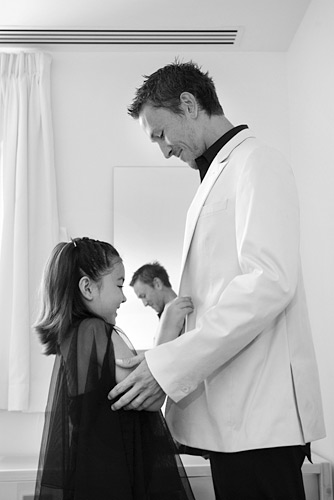
Excitement and tenderness: you can’t beat expressions like this. Shooting from below the little girl’s eye line allowed me to frame the faces on the same horizontal plane. ISO 400 f/4 at 1/90th
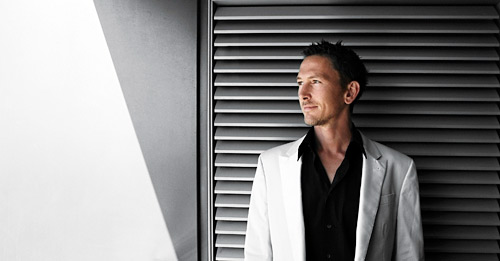
Everything came together for this pleasing portrait: lovely directional light, strong shapes and a wonderful expression. It all began with that slatted ventilation duct which was just crying out to be used in a picture! ISO 200 f/4 at 1/500th
Top tip No 2: Study photographs and paintings to find out how they work. Discover what makes an image great. learn to read a picture and to break it down into its core elements. This deconstruction will help you to develop your craft skills and to see potentially great images unfolding in front of you at weddings. Most importantly allow your picture shooting style to evolve continually and keep looking for new ways to develop it.
I was told some wise words a few years ago; “The best photographers steal ideas and adapt them while the worst photographers simply copy the work of others”. In practice this means be inspired by the work of painters and other photographers. However the sooner you go on to develop your own ‘look’ the sooner you will command high enough fees to make a decent living.
Whatever the situation Julie and I find ourselves in at a wedding, our first step is to assess the light around us. When we enter a room or anywhere that we are going to be taking photographs, we immediately consider the direction and quantity of light. We then look at the suitability of backgrounds. For example, when Julie photographs the bride getting ready, it’s quite normal for her to rearrange the position of the people and some furniture in the room so that the bride is well lit against an uncluttered background. Both the uncluttered and well-lit factors are trademarks of our style. We take a pro-active approach to getting this type of image. We certainly like to set up and simplify the environment we shoot in.
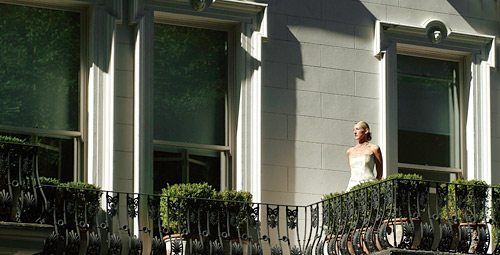
Sunlight on the balcony picks out the bride. Another colour shot in pastel shades – strong saturated colours don’t really go with minimalism! ISO 200 f/4 at 1/2000th
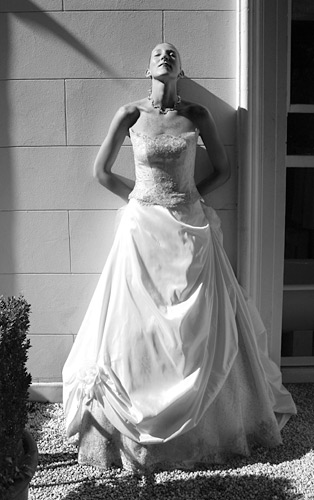
This is another bold composition in which Julie used the sunlight to create an almost sculptural effect. ISO 400 f/4 at 1/4000th
Top tip No 3: Keep the following three core facts in the back of your mind when making equipment or other investment decisions:
• The photographer sees the picture
• The lens makes the image
• The camera records it
Obvious I know, but it always amazes me to see photographers blaming their cameras for producing bad pictures. A great photographer could shoot a wedding on a Nokia phone. It’s what you see that counts. If you are skilled enough to see great pictures, then invest in excellent lenses to make the images for you. Great lenses really do make a difference. If you struggle to see great pictures or you feel you are missing opportunities invest in yourself. Learn how to see the light and understand perspective.
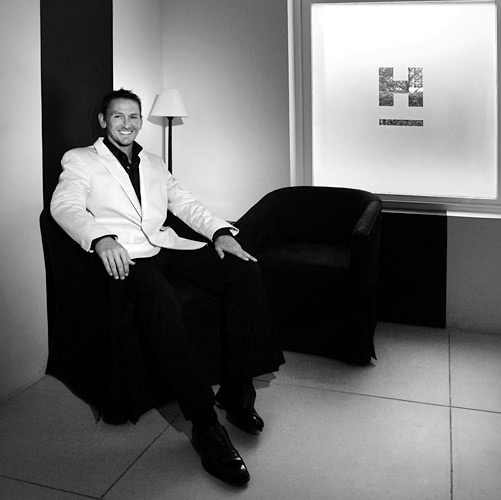
Whilst Julie is doing her stuff on the balcony, I’m having fun too. Here I have added a spot of light from a 300w tungsten lamp with the barn doors cropped in tight to attenuate the light. It’s easy to get too serious when trying create cool compositions – raising a spontaneous smile like this can be priceless. ISO 800 f/4 at 1/60th
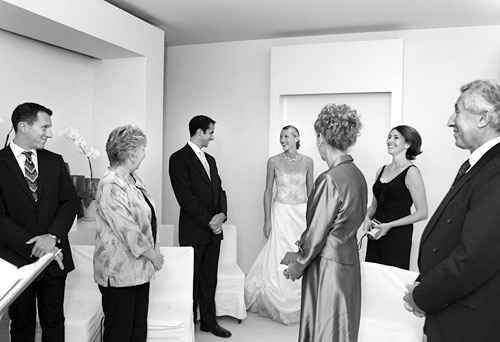
This is one of those shots you couldn’t set up even if you tried: the moment when the bride enters the ceremony room. Julie’s timing was crucial. The expressions, body language and design are all spot on. ISO 800 f/4 at 1/60th with hand held off camera flash.
Top tip No 4: Be prepared for change. The wedding market is moving fast and the next products to be big in demand may well use hybrid media combining video, stop frame animation, and stills delivered on High Definition DVD.
These are exciting times, and the digital revolution has finally arrived with multimedia meaning just that. I don’t have a crystal ball but the merging of technologies in products is certainly exciting the younger generation. Just like the recent change from film to digital capture this type of product evolution will be championed by a few before being adopted by the majority.
Whatever image capture systems are used, the ‘eye’ of the photographer and the picture quality achieved will always play a big part. It’s easy to photograph the bride and groom, but it’s much more difficult to record the love that exists between them. It’s this ability to shoot love, fun, tenderness and beauty that makes the work of the great wedding photographers stand head and shoulders above the rest. The same is true for filmmakers; no amount of digital gimmicks or product types will ever change that. I came from the BBC as a cameraman into the wedding market shooting stills and I can honestly say that both disciplines use the same skills.
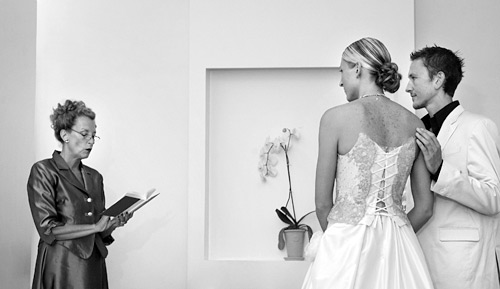
Another fine composition with a touch of tenderness against the cool, geometric background. ISO 800 f/4 at 1/60th
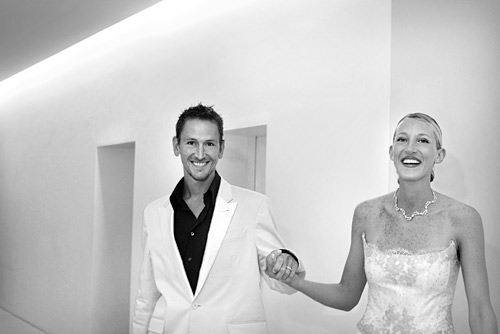
As the happy couple come towards me, I’m walking backwards holding a TTL flash in my left hand above the camera. One way or another, it’s a moment of fun and spontaneity in which the couple’s expressions reflect. ISO 800 f/4 at 1/60th
Top tip No 5: Plan each wedding day thoroughly. Julie and I plan our involvement in every detail of each wedding schedule like a military operation. Why? Firstly, because we want to achieve high standards we need to use our time efficiently and secondly, because we don’t want anything to take us by surprise. So instead of waiting for problems to happen, we try to identify and rectify them as early as possible.
For instance, a 4 PM ceremony at a Castle in Scotland in December probably rules out any pictures of the bride and groom together in daylight. If like us, you are happy to use available light and/or make your own, then this might not be a major problem. On the other hand, if you point out what exciting pictures of the couple you could take by daylight in the castle grounds, the bride and groom might be happy to be ready by 2 PM for an hour of photography before the guests start to arrive for the ceremony. Stay creative and open-minded at the planning stage and most problems will disappear on the wedding day itself.
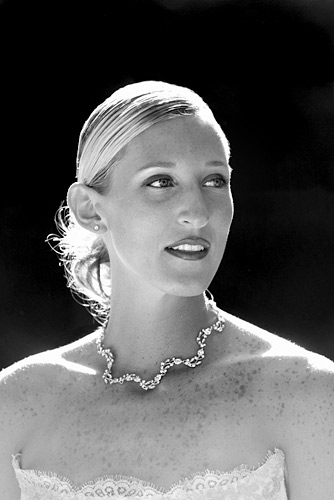
A stunning image: the bride was lit beautifully by the late sun shining through some distant trees. We always use Photoshop when an image demands it – in this case the dark bushes behind the bride were rendered to black. ISO 800 f/4 at 1/700th
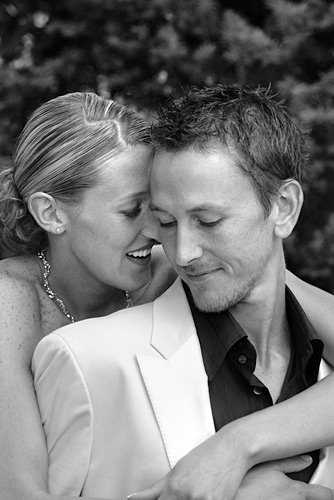
Stepping back out of the sunlight of the previous picture and just using the bushes as a backdrop, these intimate moments were set up and then captured spontaneously. Sometimes couples make their own magic! ISO 800 f/4 at 1/180th
Top tip No 6: Put yourself first and plan your business and your future around your personal needs.
In the service retail sector we can be all too valuable for our own good. The truth for most wedding photographers is that rather than owning the business themselves, the business owns them! It’s far too easy to think that you have arrived when your name is in lights above the door of your studio and your photography is in demand from your local community. Even with this level of success, taking extended holidays is expensive because if you’re not shooting, you’re not earning. Ill health is a big risk too and some sort of income protection insurance might be a wise purchase. It doesn’t have to be this way and there are many examples in service retail where the business owner enjoys a life of relative leisure where family time comes first. In chapter eight of my book I explain the rudiments of strategy planning to ensure you have the lifestyle and holidays you deserve.
Part of our own strategy is to cut right back on weekend weddings from September 2008 when our daughter goes to secondary school. It is very important for Julie and I to spend weekends with our family. We’ve planned for this for two years now and we are on track to make it happen. We have an eight-year personal plan and every decision we make now has that plan in mind.
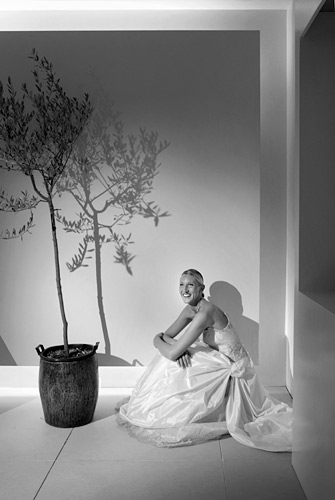
It pays to prepare. After setting up my small 300w tungsten spotlight (with barn doors for greater control) on a stand, and planning a trio of shots with Julie, we called in the bride and groom. Panning the light between pictures allowed its stand to stay in the same place whilst we shot the pre-rehearsed images in quick succession. ISO 400 f/4 at 1/30th
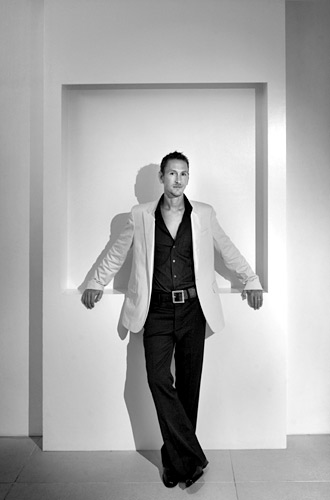
Here I created a pool of light for the groom to stand in and placed him right in the middle of the frame just breaking the symmetry with his crossed legs. I always use a monopod to hold the camera steady in these situations. ISO 400 f/4 at 1/11th
Top tip No 7: Marketing ideas are useless unless acted upon.
To put it another way, marketing effectiveness is directly proportional to levels of action or activity. I’ve been to many seminars and seen photographers scribbling down undoubtedly fantastic marketing ideas only to discover none of them were ever implemented. A good idea is an action not a thought. Get out there and do it. Do test and measure the effectiveness of all your marketing effort. Scale up the successful strategies and drop off the failures.
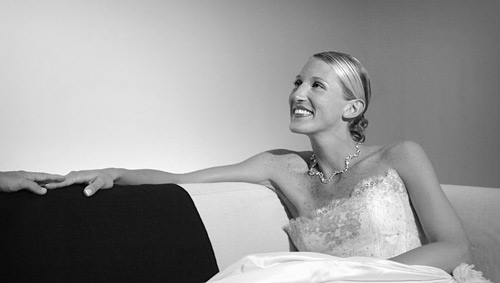
The touch of the hands and the look of love make this image work for me. The light position should have been to the left of the camera but because the barn doors kept the spill from creeping up the wall behind the bride, I got away with it. ISO 800 f/4 at 1/125th
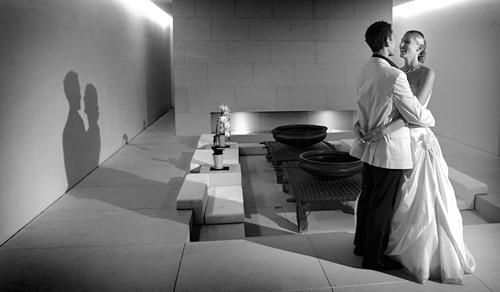
Having re-rigged my spotlight in the hotel foyer, we set about having fun with shapes and shadows – carefully controlling just one light with the barn doors. The items in the hotel nearly cluttered the shot but in black and white it’s much less distracting than it might have been in colour. ISO 400 f/4 at 1/45th
Top tip No 8: Don’t blow your own trumpet in advertising.
It’s all too easy to focus all your advertising on yourself or your business and not on your prospects. We’ve all done it, just look at any ad and ask yourself, who is the ad really talking about? Is it talking about the prospect or about the photographer? Avoid the ‘how great am I’ statements and concentrate on the ‘how great you will feel looking at your wonderful pictures’ type of phrases. This really works.
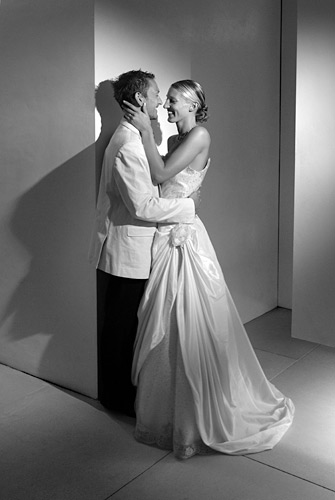
These images remind me of a love scene from a classic movie – planes of continuous tone cut with slashes of light. As usual I shoot the wide angles while Julie goes in for the close-ups. Create the moment once and capture it twice on different lenses from different angles. ISO 400 f/4 at 1/60th

Julie’s close-up of tenderness and beauty ends the hotel lobby shoot. Images like this have a very high value to the client, not just now but for generations to come. Their children and grandchildren will hold this image in high regard as it shows true passion. ISO 800 f/4 at 1/125th
Top tip No 9: Learn how to select your clients carefully.
We use the simple system of labelling potential clients as either ‘warm fuzzies’ or ‘cold pricklies’. Warm fuzzies are going to be fun to work with and it will be easy to exceed their expectations. Cold pricklies on the other hand will be hard work from the start and are likely to pick holes in the end product they receive. We choose never work with cold pricklies. I suggest you learn how to say no, or in other words advise your prospect to choose another photographer. This is a skill you must adopt to protect yourself from the anguish and pain of working with cold pricklies. Waking up on the morning of a wedding and genuinely looking forward to the days work ahead is far better than dreading photographing the bride or groom from hell.
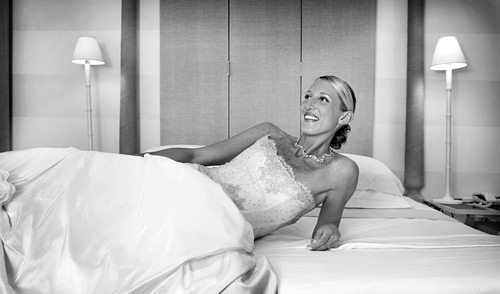
I shot this image of the bride using a splash of flash as the groom entered the room. The moment when their eyes met was the one not to miss. ISO 400 f/4 at 1/60th
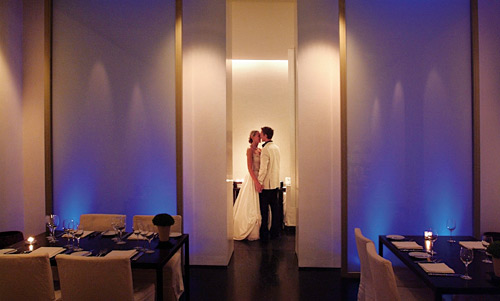
I wanted to use only available light for this shot but I had to hold my breath! I use only a monopod to keep my camera steady, so I’ve needed a lot of practice to be able to get useable shots at this shutter speed. No additional light was needed, just a balanced, symmetrical composition. ISO 800 f/4 at 1/8th
Top tip No 10: Financial mastery will eliminate financial misery.
Getting to grips with bookkeeping, spreadsheets, profit and loss forecasting, tax returns, VAT, salaries and general accounting is one of the least liked elements of running a successful photography business. However, ignoring or playing down these matters could SERIOUSLY DAMAGE THE FINANCIAL HEALTH OF YOUR BUSINESS! So please persist. It has to be done and once you understand what’s needed, you will find chasing the profit both creative and rewarding. The fact is that you could get everything else right – the photography, the service, the presentation, even the marketing – but without financial plans, analysis, controls and strategies, you could still be struggling to make ends meet.
I’ve distilled these thoughts from my new book ‘The complete Guide to Professional Wedding Photography, how to create a more profitable and fulfilling business’. One reviewer said “You are giving away so much valuable information, are you sure that this is wise?” My response was “I will get one chance in life to write a book like this. It has to exceed every readers expectation and it deserves to include everything of value I have learned about this industry”.
Damien Lovegrove.
In the last color photo you posted, what difference does the 1/8th shutter speed make as opposed to the faster shutter speeds used in the previous photos? In essence, why did you use that shutter speed?
Hi Anwar,
Thank you for your question. I set the ISO to 800 as it was as high as I wanted to go using a 6mp Fuji S2 camera. I set the aperture to f/4 because my lens was at optimum quality at that setting and I used 1/8th second exposure to accurately record the ambient light in the dimly lit restaurant. I hope this helps,
Damien.
Great photographs, I love the way you carried through the spartan theme.
Hi Sarah,
I prefer minimalist to Spartan. But hey I understand what you mean. Thank you for your compliments.
Damien.
I have your book these shots feature in. Great book!
Thanks Richard :)
Thanx Damien for Your inspirational marketing advice and most of all photography. Have your website in my Favourites.
Thanks Piotr, Do keep coming back, Cheers, Damien.
Hi Damien,
F4 ! how do u get the depth of field illustrated in some of theses examples, have they been greatly cropped into?
I’ve been using Canon’s 24-105mm f4L since it came out and I struggle to get a decent depth of field when shooting at F4 on the 5D.
obviously ive tried using less of the lens’s length but I’ve just never been happy with it.
Excellent blog by the way ive been in the business 19 years and still picking up great ideas.
Thank you
Hi Martin, No cropping on the shots – cropping a shot does not increase depth of field anyway. I always ensure if I have multiple subjects in a shot that they are all on the same focal plane. Cheers, Damien.
Give it a go Tim.
Look at any well shot drama on TV to see the effect of constant aperture shooting (nearly always f/4)
Damien.
Hi Damien. This really is a great blog, thanks for sharing your wealth of knowledge.
I’m usually varying my aperture from f2.8 to f8, so to see that all of yours are f4 is interesting. I’ll try keeping it constant at my next shoot to see how it looks. Would certainly make life easier!!
A very sincere thank you Damien very inspiring stuff and lots of very really useful info. Can I ask do you use a light meter much for exposure?
Hi Martin,
I never use a lightmeter. I use the camera screen as I can see exactly what I’ve got. I can check highlight and shadow detail and accurately asses contrast and tone. Damien.
Danke!
Alles sehr gut beschrieben!
Thanks,
Wedding Photographer ARtes
Hi Damien
Having used digital for many years I have always had the absalute fear of “blown out highlights “and as a result always moved the Bride to shade to shoot.
Then Iread your techniques and watched your vids – and it suddenly clicked !!!
Place the Bride with the light ( sun ) behind and adjust exposure – result beautiful images, no noise and an increase in sales as an additional and unrecognised benefit – why?
All wedding guests shoot over the pros shoulder, and shooting into the sun screwes up all their exposures and I get more orders
Thanks Damien
My New Rules for weddings are
1 Shoot with light behind the subject
2Use f4 on all images – for consistancy
3 Avoid sky where possible
4 Use flash at 800 iso 1/60th @f4
The only deviation from your system is to use spot metering rather than adjust exposure compensation manually – any comments on this ? and a slight downside to avoid sky where possible
Thanks once again for helping increase my reprint orders
Thanks so much for the excellent tips. Your blog is evolving into a fantastic resource that compliments your training materials very well. Tip No 3 is so true; photographers are too frequently judged by the camera they wield. It is commonly perceived as the defining item, yet as you point out, cameras are arguably the least important component of the picture making process. Anyone who has worked in a wet darkroom will appreciate that actually the quality of the lens (and it’s settings) on the enlarger affect final print quality dramatically. And no amount of darkroom work (or digital post production) will make a bad negative good.
If I were handed a box of top quality screwdrivers and spanners I’d still not know where to start in fixing my combi-boiler. I’m not a plumber. Tools are not knowledge, just kit. It’s all about what the person knows and sees, how they interact with people in anticipating a moment or creating one. And, yes good lenses are a must for reproduction, but they won’t make the picture. That’s the job of the photographer; real empathy and openness will set your portraits alive.
Hi Serge,
Thank you for you lovely comment. Please feel free to ask questions and contribute as you wish.
Damien.
Hi Damien !
Thanks for sharing. I think I’m getting addicted to your site :-)
Thank you Damien, yes it certainly does help.
I do have an SB800 which I use with my D200. However, I have just bought an SB900 so trying to get my head round that at the mo!
By the way have just received your Lighting Winter Weddings DVD and it is brilliant! It has also helped me tremendously in understanding ways in which to use flash and I shall definitely be using some of the tips at the wedding I am shooting on Friday.
Thanks again.
Jan
Hi Jan,
Flash is not just used to illuminate, it is used to add life and contrast to a scene. Just because a camera can record in next to no light it doesn’t make the light wonderful.
Using a splash of flash will add sparkle in the eyes and skin of the people you photograph. Shooting without it may just produce flat, dull, pictures.
Whether you use natural light or a combination of natural light and flash, consideration to the direction, colour and quality of the light has to be taken into account.
In dark winter interiors, I expect I’d shoot a D700 at ISO 1600, 1/90th @ f/4. That will give me 2/3rds of a stop more ambient exposure over my usual settings, with a slightly faster shutter speed to further arrest subject movement. I’d still use flash and I’d knock it back 2/3rds of a stop too.
The SB800 is a perfect companion to the D700.
I hope this helps,
Damien.
Hi Damien, Firstly Happy New Year!
I am about to shoot a wedding that is to take place at 4pm, therefore, not much chance of any natural light at all. I now have a D700 which is great in low light, however, not sure that I should shoot everything without the use of flash? I have an SB800 which I used on my D200 and presume that it will be ok on the D700? My question then is should I use your settings of ISO800 f/4 1/60th?
Hi David, It comes down to how you expose the shot. I can make ISO 1250 pictures taken on my 5D look silky smooth if I get enough exposure in the file and use a good lighting style. Underexpose by just 2/3rds of a stop and the shot will look ropey. The noise is in the shadows so give the shots extra exposure and sit the black level down in Lightroom. This will reduce the noise too. It’s just like recording music cassettes. Get the recording volume a bit quiet and there is lots of noise when you play it back.
The MK 11 is better and will need less enlargement too. – A costly win/win.
Damien.
Hi Damien,
Not sure if i send this message last week but keen to get a bit of advice on low light photography with a 5D. I find that indoor shots at 400iso or 800iso are showing a lot of noise and wonder how I can reduce this. I tend to shoot at f4 indoors and wonder if it is just the camera’s inability to reduce the noise that is the issue of is there any other thing I should be doing?
I am also considering the MK 11 if this improves the low light photography and would welcome your thoughts
Thanks for your comment FriscoD.
Hi MikeyP Yes, you are right to suggest that ISO 800 was not the ‘ideal’ choice for this picture. However the Fuji S2 camera looks fab at ISO 800 and the grain structure reminds me of TriX Pan processed in D76. I used to use ISO 800 most of the time for this reason. I can see that we were switching between 400 and 800 on this shoot. The bride and the other guests were standing in the shade and I watched someone walk through the shaft of sunlight and I thought it looked great so we put the bride in the same light and I took the shot. I left the camera set as it was for the shade shooting. The picture looks great and that is what matters.
I hope this helps. Damien
In the shot (#14) where the bride is backlit and you made the background black.
If it is so well lit why use 800ISO when you have such fast shutter available??
great notes and photo illustration. Really inspired me alot! thanks